
Translate Japanese Menus: Scan Kanji to English Instantly
Stop guessing what's on the menu. Scan any Japanese menu and get instant translations with photos and allergen warnings.
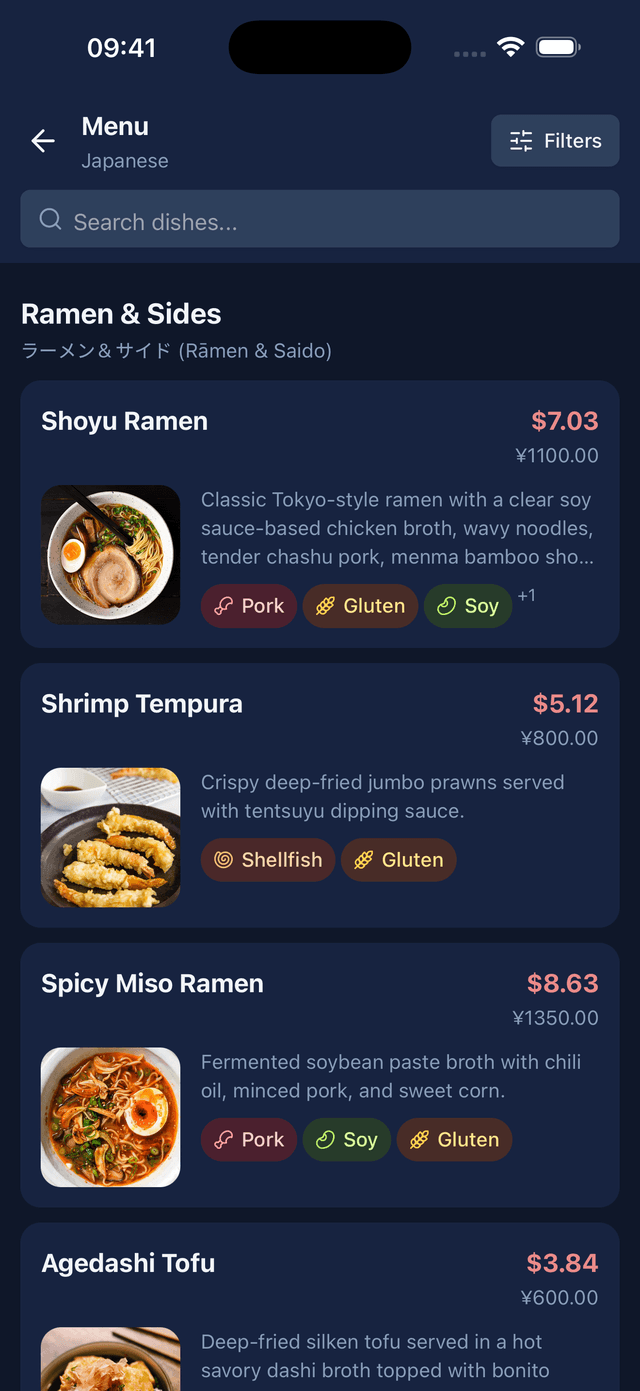
Kanji Got You Confused?
Google Lens struggles with vertical Kanji and handwritten text. You get weird translations like 'cow meat fire' instead of 'grilled beef'. MenuVista understands food context and gives you real dish descriptions.
- ✗Characters you can't read, dishes you can't identify
- ✗Generic word-for-word translation with zero food context
- ✗No idea what allergens are hiding in the dish
- ✗Pointing at the menu and hoping for the best
- →Every dish translated with real culinary context
- →Ingredients broken down, allergens automatically flagged
- →Full nutritional breakdown before you order
- →Order with confidence in any language, anywhere
Hidden Meat in Your Broth
Japanese broth (Dashi/Tonkotsu) often hides pork or fish. Many vegetarian-looking dishes contain bonito flakes. MenuVista spots these instantly so you can eat safely.
Nuts & peanuts
Hidden in sauces, marinades, desserts
Shellfish & seafood
Broths, stocks, and garnishes
Gluten
Soy sauce, marinades, fried dishes
Important safety note
Japanese broth (Dashi/Tonkotsu) often hides pork or fish. Many vegetarian-looking dishes contain bonito flakes. MenuVista spots these instantly so you can eat safely.
Not just translation.
Menu intelligence.
Translation apps were built to convert text. MenuVista was built specifically for the restaurant table.
Know what you're
looking at.
Familiarize yourself with essential japanese food vocabulary before your next meal.
鶏 (Tori)
JapaneseMeaning
Chicken
野菜 (Yasai)
JapaneseMeaning
Vegetables
牛 (Gyu)
JapaneseMeaning
Beef
卵 (Tamago)
JapaneseMeaning
Egg
豚 (Buta)
JapaneseMeaning
Pork
魚 (Sakana)
JapaneseMeaning
Fish
海老 (Ebi)
JapaneseMeaning
Shrimp
味噌 (Miso)
JapaneseMeaning
Fermented soybean paste
天ぷら (Tempura)
JapaneseMeaning
Battered and deep-fried
焼き (Yaki)
JapaneseMeaning
Grilled / pan-fried
煮 (Ni)
JapaneseMeaning
Simmered / boiled
丼 (Don)
JapaneseMeaning
Rice bowl dish
Want to translate the full japanese menu?
MenuVista reads the whole thing in seconds.


How to read a japanese menu.
Japanese menus are often organized by cooking method (grilled, fried, raw) rather than by ingredient. Look for section headers ending in 物 (mono, meaning 'things').
Set meals called 定食 (Teishoku) are the best value — they include a main dish, rice, miso soup, and pickles for a fixed price.
Many izakaya (casual pubs) use a ticket vending machine (食券機, Shokkenki) at the entrance. You buy a ticket for your dish before sitting down.
The phrase おまかせ (Omakase) means 'I'll leave it to you' — the chef chooses your meal. This is common at sushi restaurants and usually the premium option.
Lunch menus (ランチ, Ranchi) at the same restaurant are often 30-50% cheaper than dinner. Many high-end restaurants offer affordable lunch sets.
Common questions about japanese menus.
Can MenuVista read vertical Japanese text?
Yes. Unlike generic translation apps, MenuVista handles both vertical and horizontal Kanji, including handwritten menu boards commonly found in izakaya and ramen shops.
How does MenuVista handle Katakana loanwords?
MenuVista recognizes Katakana loanwords (like ビール for beer or ハンバーグ for hamburger steak) and translates them with proper food context rather than just phonetic transliteration.
Does it work in vending machine restaurants?
Yes. You can photograph the ticket machine buttons, and MenuVista will translate each option with descriptions so you know what you're ordering.
Can it detect hidden pork in Japanese dishes?
MenuVista flags common hidden ingredients like pork-based tonkotsu broth, bonito flakes (fish) in dashi, and lard used in ramen. However, always confirm with staff for severe allergies.
Translate more cuisines.
Same confidence.
Scan Japanese menus instantly
Snap the menu, understand every dish, order with confidence. Works for japanese menus and 30+ other languages.