How a Thai dish name is built
Read the name in two parts. The first word is often the cooking method. The next words tell you the main ingredient, and sometimes the sauce or herb. The English line under the Thai name can be short, so the Thai words tell you more.
- Pad kra pao moo: pork stir-fried with holy basil.
- Tom kha gai: a coconut soup with galangal and chicken.
- Yam nuea: a sour and spicy beef salad.
- Khao pad goong: fried rice with shrimp.
- Gai yang: grilled chicken.
Cooking words
These words tell you how the dish was made. They are the fastest way to guess what will arrive at the table.
- Pad or phat: stir-fried in a wok.
- Tod or thot: deep-fried. Tod man pla are fried fish cakes.
- Ping: grilled, often on a skewer, as in moo ping. Yang: grilled or roasted, as in gai yang.
- Nueng: steamed. Op: baked, often in a clay pot.
- Tam: pounded in a mortar. Som tam is green papaya salad.
- Yam: a salad tossed with lime, fish sauce, chili and herbs.
Curries and soups
Kaeng, also spelled gaeng, means curry. Some are rich with coconut milk, and some are thin and sharp. Tom means boiled, so most tom dishes are soups.
- Kaeng khiao wan: green curry, made with coconut milk.
- Kaeng daeng: red curry, also with coconut milk.
- Massaman and phanaeng (often spelled panang): curries that are usually milder and richer.
- Kaeng pa: jungle curry, made without coconut milk, so it is often very hot.
- Tom yam: a hot and sour soup with lemongrass, lime leaf and chili.
- Tom kha: a coconut soup with galangal, milder than tom yam.
Meat, seafood and other main foods
Many menus let you pick the main food for the same dish. Learn these words and you can choose with confidence.
- Gai: chicken. Ped: duck.
- Moo: pork. Nuea: beef.
- Goong or kung: shrimp. Pla: fish. Talay: seafood.
- Kai or khai: egg. Watch the spelling, because some menus also write chicken as kai.
- Tao hu: tofu. Pak: vegetables. Het: mushrooms.
Noodles and rice
Rice comes with most meals. Noodle dishes can be dry or in soup, and many shops let you choose the noodle.
- Khao: rice. Khao suay: plain steamed rice. Khao niao: sticky rice.
- Khao pad: fried rice.
- Kuay teow: rice noodles, often in soup.
- Sen yai: wide noodles. Sen lek: thin noodles. Sen mee: very thin noodles.
- Pad thai: thin rice noodles stir-fried with tamarind and fish sauce, often with egg and peanuts.
- Pad see ew: wide noodles stir-fried with soy sauce, usually not spicy.
Thai spice levels and what they mean
Phet means spicy. Many Thai restaurants abroad ask you to pick a level, as a number from 1 to 5 or 1 to 10, or as mild, medium, hot and Thai hot. There is no standard scale. A 3 in one place can be hotter than a 5 in another, so ask what their numbers mean. In Thailand, you can ask for the heat you want with these words.
- Mai phet: not spicy.
- Phet nit noi: a little spicy.
- Phet mak: very spicy.
- Prik: chili. Mai sai prik: no chili, please.
- Curries already cooked in a pot are hard to change. Stir-fries, salads and soups made to order are easier.
Reading a Thai menu with MenuVista
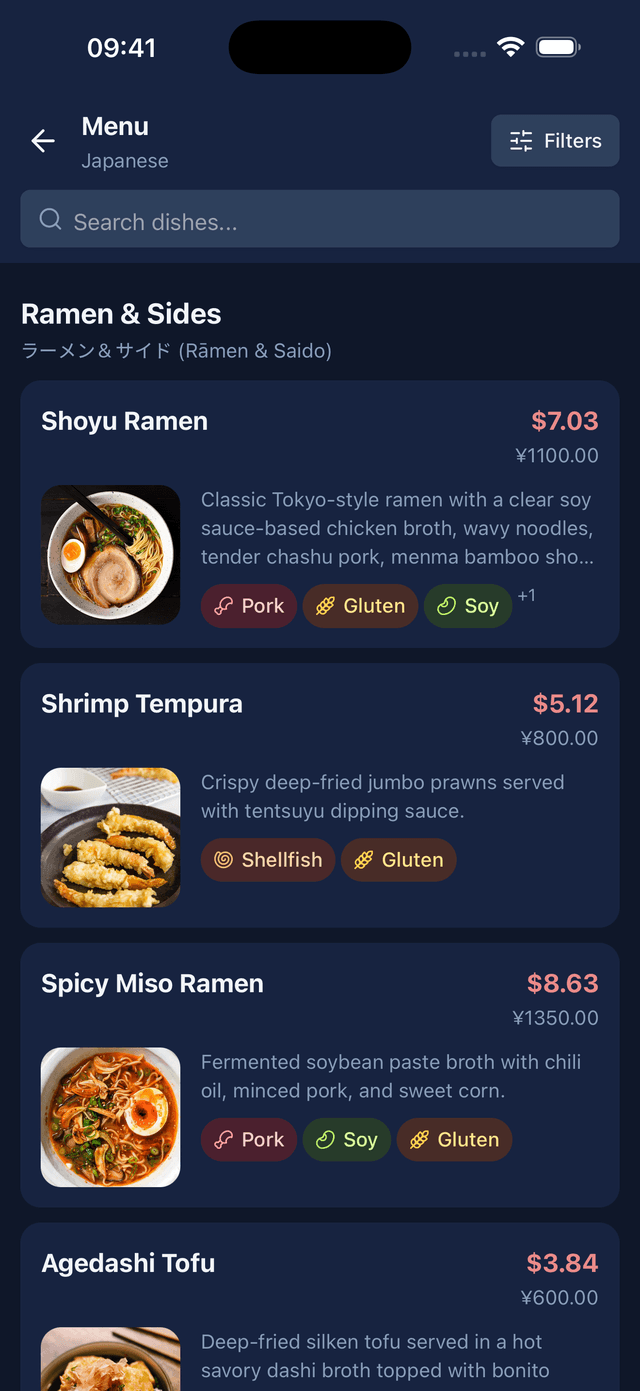
Take a photo of the menu, or upload a photo or a PDF. Handwritten and chalkboard menus work too. MenuVista reads Thai script and shows each dish with its name, a translation and a plain description of what it is, grouped under the menu's own headings. That helps a lot on Thai menus, because a word-for-word translation turns kaeng pa into “forest curry” and tells you nothing about the heat or the coconut. Likely allergen flags appear on each dish for the 14 EU allergens. When you are ready, use “Show to Waiter” and point at the dish. Free to try. No account needed.
Allergy and diet words
Thai food uses a few ingredients that are easy to miss. Fish sauce and shrimp paste are in many curry pastes, dips and dressings, even in dishes with no meat on top. MenuVista flags likely matches for the 14 EU allergens, and its vegetarian and vegan labels look at hidden ingredients too. But a flag is an estimate, not a medical guarantee. If you have a real allergy, ask about each dish.
- Nam pla: fish sauce. It is in many dishes and dressings.
- Kapi: shrimp paste, used in many curry pastes and chili dips.
- Tua lisong: peanuts. Common in pad thai, massaman and satay sauce.
- Nam man hoi: oyster sauce, used in many stir-fries.
- Soy sauce usually contains wheat, so it can contain gluten.
- Jay: a strict plant-based style. Mangsawirat: vegetarian. Ask anyway, because fish sauce is easy to miss.
Words to order and pay
In tourist areas and in Thai restaurants abroad, English usually works. These words help when it does not. If you cannot say a word, point at the dish on your screen.
- Mai sai: do not add. Mai sai tua lisong: no peanuts.
- Ao: I would like. Ao an nee: I would like this one.
- Gin tee nee: to eat here. Sai tung or ao glap baan: to take away.
- Check bin: the bill, please.