Why "vegetarian" is not always enough
The word vegetarian does not mean the same thing everywhere. Japan's national tourism office says the word is often understood in a broader sense there, so asking for a vegetarian meal may not be enough. In other places, a dish with a little ham or chicken stock can still count as a vegetable dish. So don't stop at the word. Name what you don't eat: meat, chicken, pork, fish, seafood and the broth made from them. If you also avoid eggs, dairy or honey, say that too.
Where meat and fish hide, country by country
Every cuisine has a few base ingredients that never show up in the dish name. Here are common ones to ask about. Recipes change from one cook to the next, so treat this list as a set of questions, not a set of rules.
- Japan: dashi, the stock in miso soup, noodle soups and many sauces, is often made with bonito flakes, which are dried fish.
- Thailand and Vietnam: fish sauce goes into many soups, salads, curries and dipping sauces. Shrimp paste is common in curry pastes.
- China and Korea: soups and sauces are often made with meat or seafood stock. Korean kimchi is often made with fish sauce or salted shrimp.
- Mexico: refried beans and tamales are often made with lard, which is pork fat.
- Spain: small pieces of ham often go into vegetable dishes, beans and soups.
- Italy: anchovies can hide in pasta sauces, dressings and on pizza. Many hard cheeses, like Parmigiano Reggiano, are made with animal rennet.
- France: soups and sauces often start with meat or chicken stock, even when the dish sounds like vegetables.
What to say: "I am vegetarian" in other languages
Keep your sentence short and add the broth part. Say it, or show it on your phone. Here is the same idea in a few languages. Vegans can add "no eggs, no milk" to the sentence.
- Spanish: Soy vegetariano (or vegetariana). No como carne ni pescado, ni caldo de carne o pescado.
- French: Je suis végétarien (or végétarienne). Je ne mange ni viande ni poisson, ni bouillon de viande ou de poisson.
- Italian: Sono vegetariano (or vegetariana). Non mangio carne né pesce, neanche il brodo.
- German: Ich bin Vegetarier (or Vegetarierin). Ich esse kein Fleisch und keinen Fisch, auch keine Brühe davon.
- Portuguese: Sou vegetariano (or vegetariana). Não como carne nem peixe, nem caldo de carne ou peixe.
- Japanese: 肉と魚は食べられません。魚のだしも食べられません。 (Niku to sakana wa taberaremasen. Sakana no dashi mo taberaremasen.)
- Mandarin Chinese: 我吃素,不吃肉,也不吃鱼。 (Wǒ chī sù, bù chī ròu, yě bù chī yú.)
- Vietnamese: Tôi ăn chay. (I eat vegetarian food.)
How to ask the kitchen
Ask before you order, and ask about the base of the dish, not only the dish. "Is this vegetarian?" often gets a quick yes. "Is the soup made with chicken or fish stock?" gets a real answer. Ask when the restaurant is quiet if you can. For a set menu or a booked dinner, tell the restaurant about your diet when you book. If the answer is unclear, pick a dish that is plainer, like rice, vegetables, tofu or bread.
Reading a menu you can't read
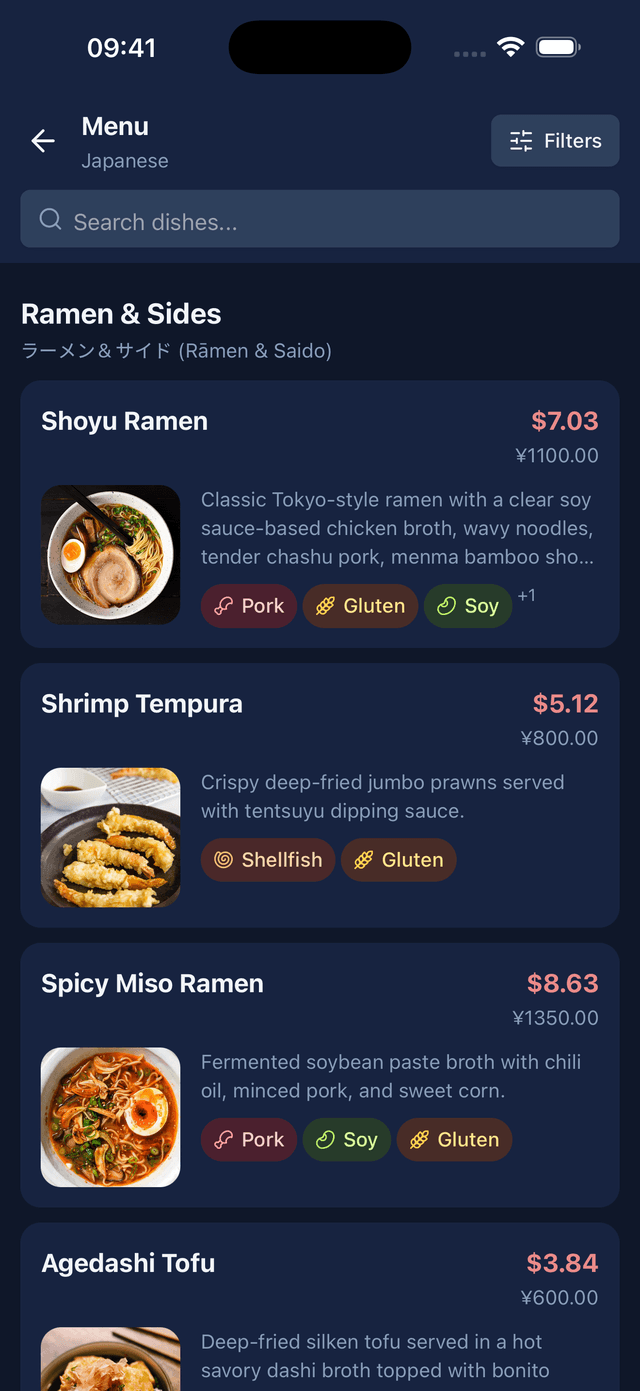
A photo menu helps, but a picture of vegetables can still hide fish stock. A menu app gives you more to work with. Take a photo of the menu in MenuVista. You get each dish back with its original name, a translation and a short description. The app can also mark dishes as vegetarian or vegan. These labels take into account all the ingredients listed in the dish's recipe, including hidden ones like dashi, fish sauce, lard, meat stock and anchovies. A label is still menu information, not a promise about this kitchen. Use it to choose which dishes to ask about, then ask.
Show your request to the waiter
When you have picked a dish, you still need to order it. In MenuVista, Show to Waiter puts the dish name on your screen in the menu's own language, so the waiter can read it. Show to Waiter is free. Show your "no meat, no fish, no broth" sentence next to it, and the waiter can check both with the kitchen.