A note on what this is
This is practical travel guidance written for people who already know how to manage their own allergy. It is not medical advice, and nothing here replaces what your doctor or allergy specialist tells you about travelling, carrying medication, or what to do in an emergency.
What restaurants are actually required to tell you
The rules vary enormously and knowing which regime you are in changes how you ask. In the European Union, Regulation (EU) No 1169/2011 requires food businesses to provide allergen information for 14 named allergens — including cereals containing gluten, crustaceans, eggs, fish, peanuts, soybeans, milk, nuts, celery, mustard, sesame, sulphites, lupin and molluscs — and that requirement covers non-prepacked food served in restaurants, though it may be given verbally as long as a sign points you to ask. The UK applies the same 14 allergens. In the United States, federal allergen labelling applies to packaged foods and does not require restaurants to disclose allergens on menus at all, so asking directly is the only route. Elsewhere, assume nothing is required and ask as though nothing is.
Why an app is not a safeguard
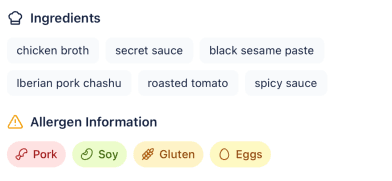
A translation app translates what is printed on the menu. A menu app can go further and infer likely ingredients and flag common allergens from a dish's composition, which is genuinely useful for eliminating twenty dishes quickly. Neither one knows what happened in that kitchen this morning. Recipes vary by region, by restaurant and by cook; the stock might be made with fish, the sauce thickened with nut paste, the pan wiped rather than washed. Use an app to shortlist and to communicate, never as the final check.
The ingredients that hide
Every cuisine has staples that carry an allergen without ever announcing it on the menu. Knowing the local ones turns a vague worry into a specific question.
- Japan: dashi, the base of most soups and simmered dishes, is usually made with bonito — fish in a great many otherwise vegetarian dishes.
- Thailand and Vietnam: fish sauce is close to universal, and peanuts appear in sauces well beyond the obvious dishes.
- Mexico and Spain: refried beans, pastry and tamales are frequently made with lard.
- India: ghee is butter, and cashew or almond paste is a common way to thicken a creamy curry.
- China: soy sauce usually contains wheat, and sesame oil is a finishing ingredient in a lot of dishes that do not mention it.
- France and Italy: butter, cream and anchovy turn up in sauces and dressings that read as neither dairy nor fish.
The allergy card, and how to write one that works
A card in the local language remains the single most effective tool, because it removes both the language barrier and the risk of a well-meaning summary. Write it short and absolute: name the allergen, name the common local foods it hides in, and state clearly that even a small amount is a problem if that is true for you. Have a native speaker check it — a machine-translated card that says something ambiguous is worse than no card, because it produces confident reassurance. Keep it on paper as well as on your phone: paper survives a dead battery and can be carried into the kitchen, which a phone usually cannot.
At the table
Timing matters more than people expect. A kitchen at 20:30 on a Saturday cannot give your question the attention it needs; the same kitchen at 18:30 on a Tuesday often can. Ask before you are seated, so leaving is still easy. Ask about the specific mechanics rather than in the abstract — whether the fryer is shared, whether the sauce is made in-house, whether the same board and knife are used — because “is it safe?” invites a polite yes and “is the fryer shared with the breaded fish?” invites a real answer. If the answers are vague, that is an answer too.
Before you fly
Carry more medication than the trip needs, in hand luggage, in its original labelled packaging, and check the destination's rules for carrying adrenaline auto-injectors — several countries treat them differently and a few require documentation. A short letter from your doctor, translated, covers both the airport and the hospital. Save the local emergency number: it is 112 across the EU and in many other countries, 911 in the US and Canada, 999 in the UK. Check whether your travel insurance treats an allergic reaction as a pre-existing condition, because some policies do.